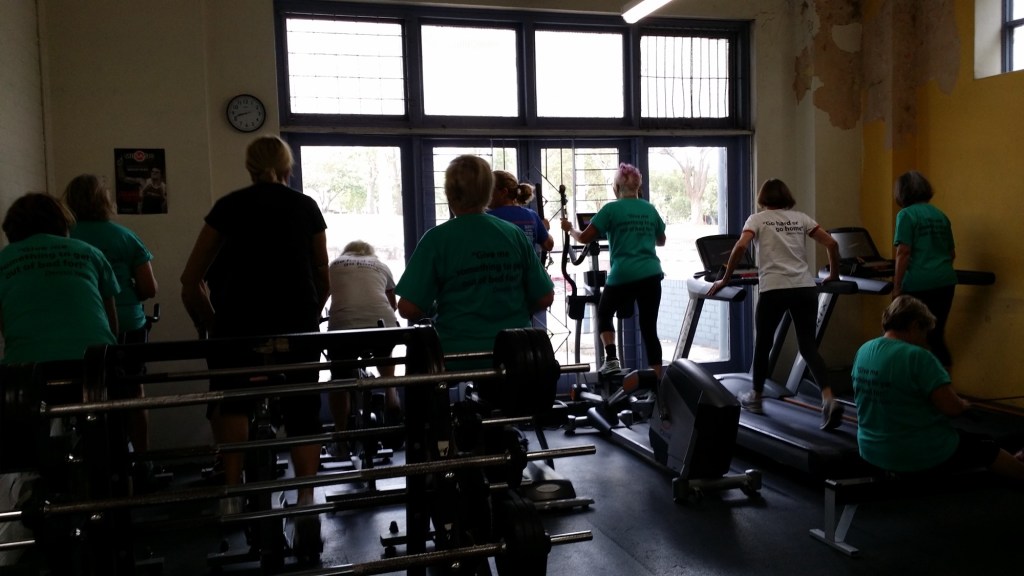
Retirees taking the time to build muscle to help themselves reduce the risks of age-related illness by working out in a group – setting to off-set the on-set of ageing”
We are all ageing.
We all lose strength & bone 🦴 mineral density as part of the ageing process.
We are all ageing.
We will die eventually. Nobody gets out of life, Alive.
I hypothesise that there is a direct observable CAUSE & EFFECT relationship between a person’s MOBILITY & MUSCLE 💪 BUILD & STRENGTH.
My understanding is that There is a 1% decrease in strength every year after the age of 25, more so in females than in males. By the age of 60 you would have lost > 30% of your strength and bone mineral density (oesroporosis).
This is largely a preventable cause.
My tip: do weight training (progressive)to “off-set the on-set “ of ageing. We are depreciating but the depreciation rate affects the “effective useful life of the non-current asset”(accounting terminology and analogy) from my 10 years as An Accountant/Business Consultant.
Every person has a body they are inhabiting that depreciates/ages at a different rate. Some faster than others. You come across individuals that look and behave older than their respective age.
Combined with a suitably balanced nutrition plan to suit you (age, activity level, body type etc), cardio exercise & a flexibility program, you can slow down the ageing/depreciation rate.
This would have a positive flow-on effect on the life that you’re living.
For example, the risk of living your retirement years with high susceptibility to fractures and breaks of Bones 🦴 would drop significantly.
The risk of Experiencing severe mobility issues that restrict the scope of your activities will increase. These can have severe consequences on a person’s health.
It could contribute to rising mental illness rates leading to suicide, dementia etc.
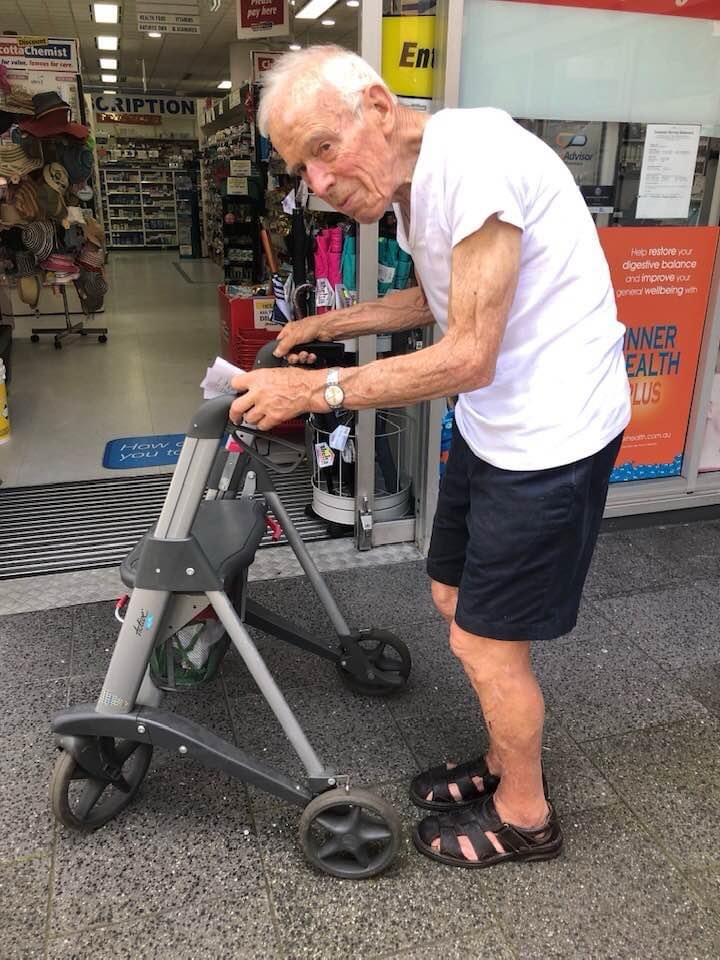
Photo (above): don’t end up like this friend of mine in the photo… you have the power to do something about this NOW).
He regrets not being made aware of the benefits of weight training & soon something preventative in his early life
It affects your mental state
Ultimately, it (immobility) affects your mental state and put you into a negative mindset. Over 25% of the aged population who have hip surgery due to falls die within a year. That’s great for doctors and surgeon’s pockets and lifestyle but disastrous for the poor individual
Change in habits now – begin the workouts you’ve been putting off and start eating 🍽 more balanced meals.
Your activity levels will have a significant impact on the QUALITY of your life, not just your length of life.
It’s never too late to start.
So… start… Just DO IT (love this original Nike slogan)
Life is about choices. Choose well.
It’s your ONE ☝️ LIFE after all (unless you have 9 lives like a cat 🐱… meow!!)
Cheers 🍻 & ahoy!
The Old Captain Viking Pirate 🏴☠️ ⚔️Muscle 💪Monk ⚔️😎 …& thoughts on ageing & mobility issues & its relationship with Muscle
We ALL need to summon the Superhero within to build & hang on to as much muscle as possible to stave off the early on-set of ageing-related illness
In my experience in the Health & Fitness Industries over the last 3 decades, I have found that the decision to include mega-loads of cardio or hardly any at all swings through the bodybuilding culture like the pendulum of a clock.
“Bodybuilding “ here includes anyone (from the skinny teen all the way to the grannies in the 90s) … who use weights of any kind to build muscles/strength and/or attempt to change their body shape.
There’s a new fad with a new name every few years or so, backed up by some new (limited) study and an awareness marketing campaign led by some famous ‘celebrity’.
Many who favour cardio claim that it allows them to eat more. That is good, right? Eating more is anabolic, isn’t it?
On the other end of the cardio spectrum, supporters of LESS CARDIO insist cardio is the most catabolic thing that can be done. They claim that it has to be avoided.
I won’t pretend to try to solve this dilemma but I will give you some facts, as I see it and have experienced it. Hopefully, it takes you closer to the doorstep of your ultimate condition.
It’s your BODY SHAPE, not BODY WEIGHT that MATTERS most.
The 80:20 Principle.
First, let’s clarify what is the actual goal in terms of physiology?
Based on one of Nature’s Principle (the 80:20 principle), the vast majority of “fat” in our body (over 80%) is collected in one form and stored in body fat cells.
The process that the body uses to consume this energy and effectively get rid of it – is called lipolysis.
I’m going to try to detail the mechanism of this process with exercise (avoiding diet for now).
In my experience of helping hundreds of individuals over the years is that I find that The difficult part is when : we have to apply these “truths” to the many different circumstances and body types that we find in the sport of Physique Artistry/Bodybuilding.
Become better at “being comfortable at being uncomfortable “ to keep your pendulum ticking … & your life, living
Everything is hormonal-driven.
Activity-related hormones epinephrine and norepinephrine speed up lipolysis greatly.
When we start working out, we firstly use the readily available energy in our blood, called GLYCOGEN. The body starts shuttling out these glycerol and fatty acids (fat) from our body fat cells.
research shows that the greatest increase in fat usage starts immediately upon exercise, hits a peak level within 5 minutes, sharply decreases, by the 15-minute mark starts to plateau, and within 30 minutes is back almost to a rate matching a control group.
So, what do we do with the common knowledge that carbohydrates (blood sugar/glucose) are used exclusively for the first 15-20 minutes of cardio?
As most of you are aware, blood sugar is the dominant source of energy used by the cells of our body at the start of exercise. As you do cardio, the body digs into longer-term energy stores, the liver (through the action of the hormone glucagon) starts pumping out stored glycogen and as described, body fat cells start releasing glycerol and fatty acids.
The question we then ask ourselves is – does the liver run out of glycogen? When it does, what happens then?
People ask – “why?” … I /My curiosity continually askS “why not?”
Seek possibilities… always
As long as Body Fat is available …
It is quite obvious that When we are exercising, we are moving the body towards an Energy Deficit.
My understanding is that the body & in particular, The liver, tries to contribute to the energy deficit.
How does it do this?
it does so by converting amino acids into glucose. I’ve learned that the liver has a reservoir of aminos available. Despite this, this process is STILL a catabolic phase. And what is “catabolic?”
Interestingly, though, even during the harshest, longest bouts of exercise, studies show that only 3 to 6% of energy is consumed from amino acid use.
As long as fat is available, the body spares protein as if it were the most precious commodity it has. Nice to know the brain agrees with us on that one. We need to dig a little deeper to get a better understanding of how the body tends to operate.
There are many variables we need to bring into the equation before we even address things like duration, frequency, and intensity.
Even a small percentage of amino acid use can add up if it’s a repetitive occurrence. I also mentioned “as long as body fat is available”…
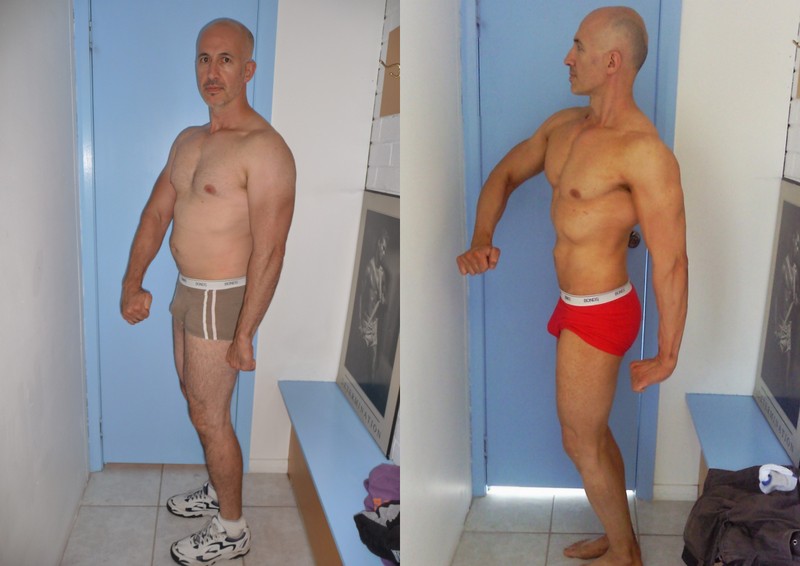
Same weight. Different body composition. The right has higher Muscle: Fat Ratio. L: 15% body fat. R: 6-% body fat.
Body Type.
Many individuals don’t get to that stage (under 10% body fat) to worry about not having sufficient body fat available to be used as Energy, during exercise.
The variable of BODY TYPE is an important consideration when deciding HOW MUCH CARDIO an individual should do. There are 3 main body types – ectomorph, mesomorph and the endomorph.
In my experience, An Ectomorph, has to have a healthy fear of “too much” cardio since they will be at the top end of the population in terms of using amino acids for energy. The more, the better, in their case.
In the middle of the spectrum, those that lose moderately slowly (like me) need to understand that muscle preservation is their greatest asset. We need to see cardio as a very necessary part of their daily habits and any kind of preparation for competition.
It has been and still is, a KEY daily habit of mine.
On the other end of the spectrum, you have the Endomorphs. For these individuals, more, rather than less cardio is the way to go. They usually have a lower metabolic rate to begin with and tend to carry a very high level of fat deposits.
The more cardio, the better.
The Rate of Lipolysis.
Here is where armchair interpreters of research often start showing that it takes more than throwing some big words around to master the subject.
KEY FACT: The rate of lipolysis is virtually unchanged whether we’re at just 25% of our VO2 max or 85%.
That means that whether you’re walking on a treadmill or slamming out 30km/hour sprints, your body is releasing the same amount of body fat to be used.
Before you say, “Aha!! I knew that slower, longer cardio sessions were the right thing to do,” don’t!
You first have to differentiate between just releasing fat to be used and actually using it.
If you maintain a slow or high pace, a percentage of the energy will come from your fat cells . That’s a given.
In the case of the former, even though the body is releasing fat to be used, when it’s not used, it simply resynthesizes the glycerols/fatty acids and re-stored as body fat.
So, we then ask other key questions like:
1. Due to a slower rate of usage, should one just perform a longer duration and ultimately use the same amount of calories as someone doing a shorter but harder session?
2. Which will use more body fat and which will be less catabolic?
You should Keep in mind that the body has a vested interest in using these fatty acids for energy.
It doesn’t take a rocket scientist to deduce that Glucose and glycogen (the energy currency of our body & brain 🧠), aren’t in endless supply.
It’s obvious that when activity levels increase, the body needs to turn not only to its larger material source of energy, but it wants to be efficient at it. Remember that – it wants to be EFFICIENT AT IT.
As the RATE OF LIPOLYIS is increased, so is the blood flow to the exercising muscles, and so are the chemical processes that convert the fatty acids into usable energy.
TWIST IN THE ROAD.
Here is yet another twist in the road.
As intensity increases, these glycerols are used at a higher rate – a good thing. But, when exercise intensity reaches a level where blood flow is necessarily shunted more sharply to the working muscle tissue, blood flow to the available fat stores is restricted tremendously, decreasing the rate of fat that is made available to be used as energy.
That is why I tell all my former students that the OPTIMAL TIME to do cardio & burn more fat is first thing in the morning, upon waking and … on an empty stomach.
Like I said earlier , If we perform light cardio we release just as much body fat as high-intensity work. What is the risk of losing muscle here?
Answer: the risk of losing muscle is low.
However, but then due to a slower rate of fat usage, we simply re-store the released body fat.
So, you may be thinking – “why don’t We just do longer sessions of low-intensity cardio?”
Yes, you could but it would not be the most effective use of your time. And why?
Well, research shows after 30 minutes, fat release actually decreases – not increases as conventionally taught.
Trying to keep every variable straight is like trying to catch a greased pig. It’s like the squirrel in the animated movie Ice Age; as soon as you stick every available finger and toe in the leaking wall of ice, another confusing point of physiology springs out of a new crack.
No wonder there isn’t a consensus on the subject.
As I mentioned in the beginning of the article, you would be making a mistake if you take this article as covering every facet of the subject – think of this as just an outline and the book isn’t finished.
Seeing your progress, any progress, however small, is a motivating factor.
ACTION PLAN.
Read on for an action plan…
The ease of your body’s ability to burn body fat will affect how much cardio you do. This is depended on your body type & genetics.
Being that all of cardio is catabolic, you want to do the least you have to in order to be shredded.
For some that may mean twice a week and for others that may mean twice a day.
Consider two glaring facts:
One: Your body immediately starts releasing body fat with exercise and continues for 30 minutes until the law of diminishing returns virtually eliminates any further benefit.
If we are going at too slow of a pace, the released fat gets re-stored and if we get too high in our intensity, we shunt blood flow away from fat cells. As such, I believe, there are two types of cardio that we can benefit from and still meet our goal of sparing as much muscle as possible.
The first is thirty-minute sessions at a good pace – heart rate sustained at 130-150 beats per minute for most people. Remember, even at just 25% of our VO2 max we’re going to be releasing all the body fat that we can, but we need a pace that will actually use what is released, but not so much intensity that the body goes into a fight-or-flight mode channelling blood to the muscle tissue systemically and away from the adipose cells and organs.
The best natural bodybuilding athletes/champions know and understand how to do this better than almost everyone. Their “Double-edged sword” of keeping /maximising muscles and maximally losing fat is the challenge /opportunity.
I also believe the value of super-high-intensity cardio is tremendous but you have to weigh the catabolic effects and the fact that it won’t take long to be counterproductive and decrease the amount of fat actually being released (due to the changing blood flow patterns).
I would recommend using high-intensity sessions 1 to 3 times per week for 15 to 20 minutes to create longer-term fat usage through the increased metabolic effects.
Ectomorphs may have plenty by doing just 10-minute high-intensity sessions, but even endomorphs shouldn’t do more than 2 to 3. The amount of actual leg muscle recovery necessary should be a limiting factor – you’ll need to recover almost like a leg workout.
A major turning point in Alan’s life was coming to me for help. I helped him, help himself … build his bridge from where he was to … where he wanted to be.
Saved his job … saved his marriage … saved his life.
Base-line
The “baseline” 30-minute sessions could be done daily or even twice a day for those who lose weight slowly or have more lower body stores to contend with.
That doesn’t mean that longer, slower cardio is worthless, you just get a fraction of the fat loss after the first 30 minutes.
Breaking up an hour of cardio into two sessions can net more fat loss if the pace is high enough and consistent. This is what I do. I try to do 30 minutes walk in the morning on a treadmill and another in the evening if I have the time.
The great thing about human performance research, however, is that we’re still very much in a pioneering phase.
Studies conducted with different variables keep adding to our understanding and more specific information is sure to be discovered.
Education through a perception of the truth. Increasing your awareness, taking sufficient and appropriate actions and adapting accordingly is key towards self-improvement. All done in my programs. I love 💓 helping people who strive to help themselves by increasing their awareness… of the power & ❤️Itality within themselves. It’s never too late to learn and UN-learn bad gym (& lifestyle ) training habits learned in different phases of life. Photo: Former pupil – ex Australian Rugby Union Wallaby Captain – Phil Waugh embracing new knowledge. Having a Growth mindset. Vv
I have been very fortunate that in over twenty three years of training in the gym I have not been seriously hurt in any way. I am very proud to say that in that time I have not seen a physiotherapist or chiropractor for any training-related injury.
I have always been a stickler for form and ideal exercise execution. Always. Accelerated increased awareness from the guidance from some of the best coaches in various fields such as martial arts, power-lifting, boxing, athletics, squash, soccer, hockey, rugby and resistance-training has also contributed heavily to me staying injury-free.
Mastering the basics in any physical endeavour is paramount to you excelling in and enjoying the experience while doing it. Everyone that I have ever helped over the years get educated in applying the basics of training all the time – not some of the time! This loosely applies to most worthwhile goals in life.
Getting injured is a pain. Apart from the physical pain, one has to endure days, weeks or even months of re-habilitation. It can drain one of mental and emotional energy too and be quite costly if the injury is very serious.
Hey, there are many professions that thrive on you getting injured – physiotherapist & chiropractors are two. So, if you’re stubborn in your old habits … just keep doing what you’re doing … & “open your wallets” to them.
Over the years, I have adopted certain routines with deliberate practise (habits) that I believe decreases my chances of getting injured while training in the gym.
Below are 5.5 key tips to help you lower your risk of injury:
My whole goal from the very first time I lifted weights was to build a more balanced and symmetrical physique. I believe this is one of the main key factors in me staying injury-free all these years. This is despite me lifting relatively heavy weights for most of this time (especially the two years when I trained for the World Championships in New York).
For example, a lot of people train the ‘mirror muscles’ more than they do the muscle in their posterior chain (muscles you don’t see in the mirror). This leads to asymmetry and muscle group imbalances.
Not a wise thing to do.
Focusing say, on your chest and shoulders and biceps (the ‘show-me-your muscles muscles) and neglecting your upper back muscles like the traps and rear delts and middle back can spell disaster. The most common gym-related injury for young men world-wide are shoulder injuries primarily because of this.
Muscle imbalances lead to increased risk of injury in the respective joints and muscles.
Besides, why do you want to be the strongest or biggest guy when you can build the most balanced and symmetrical physique for your frame. This is more aesthetic and more pleasing to the eye.
So, leave your ego at the door and work towards a better shape – a more balanced and symmetrical physique. If you don’t, you may regret it later.
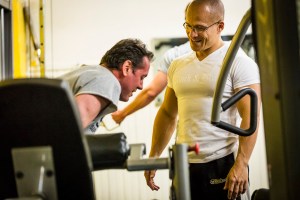
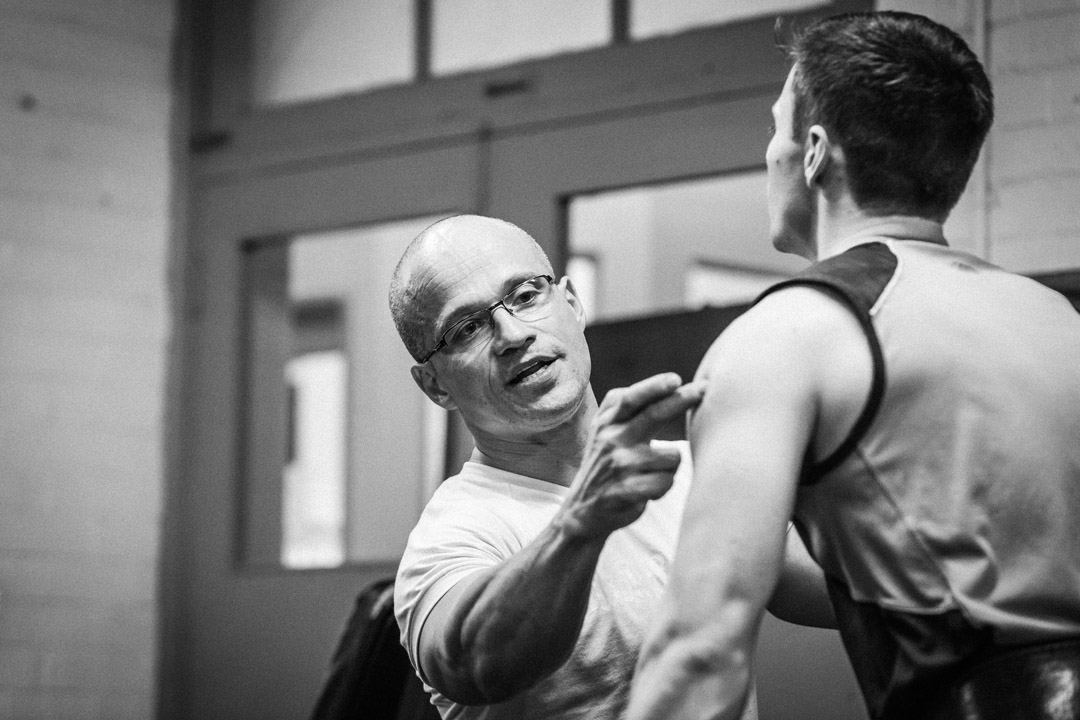
Results with care. Here, Brad is ‘feeling the essence’ of the exercise and inching closer to his best self. He is in total control and ‘feels’ the muscle being worked. Vv
Tip #2: Be aware of your breathing technique.
I believe incorrect breathing technique is one of the main contributors to getting injured when training in the gym. Keep this in mind – for:
Pushing motions (bench press; shoulder press) – exhale at the point of contraction (when your arms are furthest away from you)
Pulling motions (lat pulldowns; biceps curls) – inhale when your arms are furthest from your torso.
Breathing also helps you with the next tip.
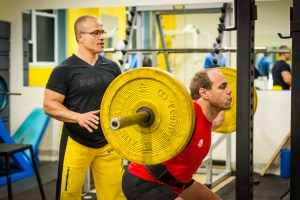
Ex-Australian Wallaby Captain – Phil Waugh performing a set of squats. Using good exercise technique(which includes proper breathing) is paramount to success.
Tip # 3: Focus!
Concentrating on your breathing and what you are going to do with the weight for those 15 to 45 seconds (a set) is critical to lowering your risk of injury.
Every fibre and cell in your body needs to 100% fully-focused! Don’t get side-tracked by other conversations and mentally block out all distractions. Focusing certainly aids you putting on good lean muscle. Period!
A slight loss of concentration could lead to less than ideal execution of exercise leading to increased levels of risk of injury.
I have developed quite a few formulas relating to peak performance over the years and one of the most important ones is:
“Focus = Results” (a shortened version of my formula).
Tip # 4: Always assess exercise execution with ‘risk:benefit’ ratio mind-set.
Exercise choice and safety – a particular exercise that may be safe for someone may not be for another.
High-risk lifting – improper execution of certain exercises can increase levels of risk for very small increments in benefit. The range of motion of exercises need to be tied in to the ‘risk:benefit” ratio of the exercise and the trainee’s goals
Always avoid “high-risk’ lifting. This relates to variables such as excessive weights; excessive number of repetitions; excessive range-of-motion and so forth.
Tip # 5.5: Apply correct training principles.
I’ve always believed that building muscle is like LIFE. It relies on two principles:
There are many principles to building and keeping muscle and after 23 plus years in the gym I have concluded that the two above and this next two principles – 3) control and 4) feel are key towards lowering your risk of injury.
All beginners and intermediate trainees or less experienced gym enthusiasts should master these before ‘going heavy’.
When you keep it simple and focus on the full range of motion of the exercise with continuous tension, you increase your ability to build good, quality muscle.
Because you are 100% focused and are using the right weight for you to correctly execute the exercise, you have better control and feel. This allows you to ‘work the muscle, not the joint’.
If you can’t control and feel the muscle being worked, you’re not building muscle, only ego.
A lot of people still aspire to the ‘No pain, no gain’ maxim but I think you should not follow this. Listen to your body: never do anything that hurts and don’t train if you hurt yourself or suffer from an existing injury.
results. Vv. “> Chris enjoying a well-deserved rest between sets. A ‘set’ as I define it is: a continuous progression of 15 to 45 sec ‘focused moments’. Focus + heart + visualization ===> results. Vv.
Most injuries happen over time, through cumulative effect of muscular discomfort and micro-scopic tares and inflammation of tendons and ligaments around the joints. Most injuries are the result of an imposed force exceeding the structural strength of the involved body-part.
Don’t copy the super-stars and genetic elite who look and train the way they train because most of the time you don’t know their full story and so this may give you a false sense of direction and could lead to injuries.
Those who don’t do away with the maxim ‘no pain, no gain’ and try to train like the super-stars usually regret it, sooner or later. A better maxim to adopt is ‘No brain, no gain”.
Strive to Train SMART. What I mean by this is that I have always promoted a more conservative approachto training. My own experience and what I have learned from observing countless other trainees – has taught me that a more conservative way to training is not only the most effective but also the safest way to train not only in the short-term but more importantly for your long-term health.
Strive to stay injury-free. You’re in the gym to work on making that person you see in the mirror (you!) – better. Not for ego.
You want to still be doing this activity and off-setting the on-set of ageing (by building muscle) well in to your 80s and 90s if you live that long. It will certainly add quality to your life. Like I have said before, Muscle is the potion of youth!
All the best in your training this year.
Embrace my Triple A to self-improvement: be more aware; take appropriate actions and adapt accordingly to reach your goals in life.
Cheers and Happy January to you!
Until next time,
Just like friendship, genuine muscle requires a lot of time and hard work to be built and sustained. You do this by adopting an ‘adaptive strategy’ of self-tuning. Vv.
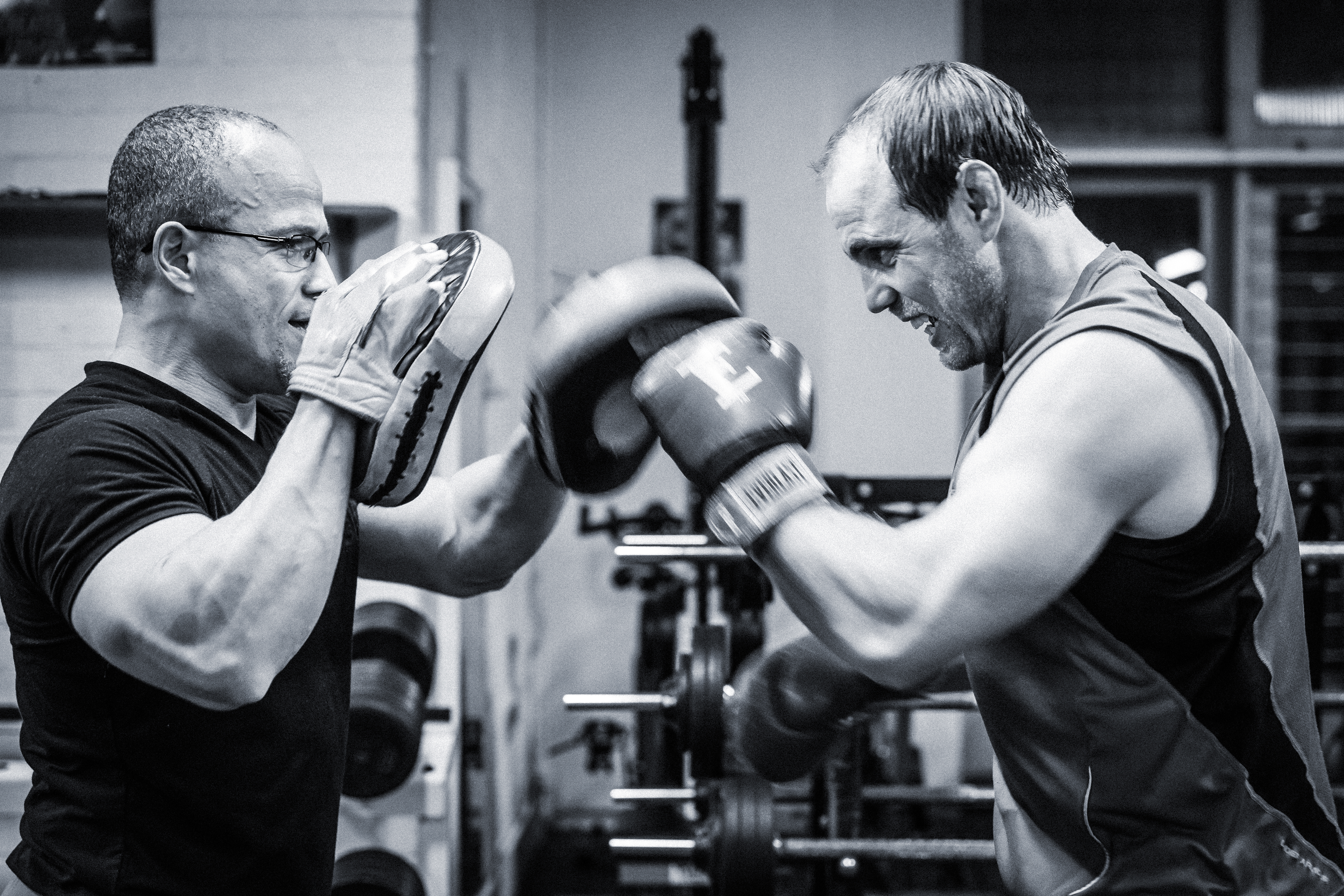
Complementing Phil’s weight-training session with a bit of light boxing in his body re-engineering program. Student achieving success in one of my programs: Retired former Australian Wallaby & Waratah Captain – Phil Waugh. Champion Results from a Champion Attitude with a Champion Program.
Well, what do you think?
Sweat … heat … smell ?
Before I tell you what they have in common after over 23 years performing them and helping hundreds of people perform it better, let me share with you a story of a member of a gym I used to own for seven years. Let’s call him Bruce.
Bruce had been a loyal member for close to 30 years. He was an intimidating but a very likeable, straight-to-the-point, anti-status quo, intolerant to ‘bs’ sort-of-a-guy.
My kind of guy – I liked him.
Now, I love observing behaviour and it didn’t take me long to see the repetitive nature and predictability of his workouts, which he religiously performed three times a week. He always did his abdominal sit-ups at the end of his workout and I noticed he did his two favourite exercises. They were:
Roman-chair sit-ups (incline crunches off an incline bench)
Crunches (off the floor)
One day, he was in the middle of his workout when he got a phone call. I then learned that he had a new girlfriend and he thought she was quite special. It was early in his relationship but he was already being pressured in to rushing his workouts.
She wanted him to spend less time in the gym. She thought that 3 times per week for 45 minutes at a time was too much time. He told me that she was always interrupting his workout when he was doing his abdominals.
I asked him how many repetitions he did for his abdominals, and I learned that he did about 400. I asked him how long he took and he said it could be anything between 10 and 15 minutes. It was a third of his workout time!
Too much if you asked me.
I thought it was quite excessive for the goals he was trying to achieve. I asked him to perform a number of repetitions. He was doing them but was not focusing on the technique. A lot of technique goes in to training every muscle group and the abdominal region is no different.
I asked him if he would like to learn an alternative approach. An approach that would reduce the number of repetitions to 30 which would mean he would spend less time in the gym, his new girlfriend would not be so irritated and he would spend more time with her.
Well, I told him that I did not ‘work’ my abdominals directly and don’t do anywhere near the number of repetitions he did but I had a ‘6-pack’ and he didn’t.
30 reps done properly. That’s all you need to do in the gym
If I was preparing for a body-building contest, I would maybe work them directly at least once per week in the last month leading up to the contest. Otherwise, they (the abs) get are indirectly worked every time I lift weights. It is the most worked muscle group in my body because of the way I approach every rep of every set of every exercise.
I don’t do anything near the number of repetitions that he was doing. 400 was excessive.
So, I told him to reduce the types of exercises he performed from 2 to 1. Let’s get you to remove the roman chair sit-ups”, I said. Let’s simplify things.
He was a little apprehensive but he accepted the change if it meant spending less time in the gym and because of his desire to spend more time with his new love was exemplary. I admired him for this.
I told him it wasn’t how much you do, it’s how you do it. An important key is the breathing technique during each repetition, something he was not aware of and was not practising.
My goal was to show him how he could do 30 ‘good’ sit-ups and not 400 and ‘feel’ the difference. He performed it as I directed and could not believe the intense feeling he was feeling only after ten repetitions.
He was convinced.
He couldn’t believe that he learned a more efficient, more effective way to work his abdominals after over 30 years of training them a certain way. That is why ‘practise does not make perfect as a person could be practising something all his life but practising it WRONG.
Instead, PERFECT PRACTISE MAKES PERFECT!
Brings me to the one similarity that sit-ups have in common with sex: that it is QUALITY rather than QUANTITY that matters.
Just like Bruce, every person I have ever trained have been made aware of how to ‘work their abs’ with quality in mind. They all have felt the difference and have spent less time doing it and unnecessary repetitions. Less time, better results.
Be YOU. No one else can do better than you at being YOU. Being the best you can be is probably the single most powerful thing you can do to improve the world. Just find YOU and then …. improve you. Sculpturing a better you with weights helps re-shape your physique but also your brain wiring.
A winning formula!
Now, most of you know how to ‘work’ your abs and muscles by now. Here are a few pointers for you when doing sit-ups:
Keep it simple.
Breathing correctly to maximize benefit is essential (breathe out at the point of contraction)
Lay on a flat surface (preferably on the floor) with your legs up and ankles crossed, with your hands behind your head.
Breathe out as you lift your head towards your knees
Go as far as you can, keeping your tummy tight (focusing on your exhale on the upward phase and inhaling as you return to the starting position).
Repeat 30 times.
It is very important that you don’t pull on your head as you come up, and you should keep your shoulders and back relaxed. Your hands are meant to be behind your head for support only.
Go ahead and make this change. See the difference.
One crunch – one rep at a time with quality, not quantity in mind. And remember, practise does not make perfect. Perfect practise makes perfect.
Just like sex.
Enjoy!
Until next time,
Cheers and Ahoy!!
The old Captain Viking Pirate … & his thoughts and words on similarity between working your abs and sex.
Each rep of every set of every exercise is an opportunity for a person to connect with the muscle group he or she intends to. The right mix of tempo, control, continuous tension and feel is critical. Executed properly, under an experienced eye, allows one to bridge the muscles with the mind. Practise does not make perfect. PERFECT PRACTISE MAKES PERFECT!
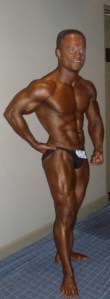
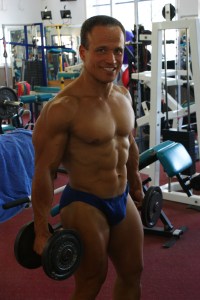
Working out in my gym during a photo shoot. You can see that I carry my ‘6 pack’ with me wherever I go. So, I don’t need to drink alcohol … I’m always drunk ha ha ha !
My claim: – The world’s BEST Energy & VITALITY Coaching Conversationalist –










 Changing lives. Empowering people. One life at a time.
You must be logged in to post a comment.